


A date change may be possible subject to availability and provided that the terms of the package/suppliers allow it. There may be an additional charge and/or a price difference. Please contact us to verify and for details.
Additional Visit to Monemvasia
Guided tour of Ancient Olympia led by a certified tour guide
Hydra–Spetses cruise departing from Tolo
“A JOURNEY THROUGH THE HISTORY AND BEAUTY OF OUR HOMELAND.” All the history, culture, and unique natural beauty of the Mediterranean come to life before your eyes on a fascinating journey through the Peloponnese. A place full of imagery, legends, and authentic Greek beauty, where every destination has its own distinct identity and its own story to tell. The imposing Monemvasia, the rugged beauty of Mani, Byzantine Mystras, romantic Nafplio, and the historic routes of the ancient land of the Peloponnese unfold uniquely before our eyes. And we, in the role of the traveler—the observer—enjoy a vivid journey through time, where the ancient and modern history of Greece meet natural beauty and tradition. We visit the homeland of Helen of Troy and the Atreides, the land of Ancient Sparta, the sacred olive tree, and the Olympic Games. A place where war, peace, culture, and the myths of Greece come together to create a unique setting against the backdrop of one of the most beautiful destinations on the Greek mainland.
Join us in the Peloponnese because…
We’ve put together a comprehensive and carefully curated itinerary for you, filled with significant visits and unique experiences.
We’ve arranged accommodations in Tolo, in historic and geographically ideal Sparta, and in cosmopolitan Patras.
The hotels we’ve selected are centrally located, well-maintained, and offer excellent value for money.
In addition to breakfast, the package includes 4 dinners for added comfort and hospitality throughout the trip.
The tour guide is experienced and knowledgeable about the region, which is particularly important for such a rich and historic itinerary.
The tour includes a guided tour by a local guide in Ancient Olympia, one of Greece’s most important archaeological sites.
We visit the “Gibraltar of Greece,” the enchanting Monemvasia, a place where time seems to have stood still.
We’ve been organizing tours to the Peloponnese since 1988, with experience, consistency, and a passion for quality travel.
Thessaloniki "Macedonia" Airport (Google Maps)
We set out early in the morning at 5:00 a.m. because our day is going to be extremely interesting even before we reach our final destination. After a few necessary stops for coffee, we’re off to find out what the future holds. And what better place than Delphi, home to the famous oracle? Delphi was the navel of the earth, where, according to mythology, the two eagles sent by Zeus from the ends of the universe met to find the center of the world, and for many centuries it served as the spiritual and religious center and symbol of unity for ancient Hellenism. We’ll spend some time at the Museum and the Archaeological Site of Delphi, and we’ll leave deeply impressed by the mystical atmosphere. Continuing on and passing through Itea, Galaxidi—a route that runs parallel to the Peloponnese—we’ll stop in Nafpaktos, a city steeped in history with its picturesque Venetian harbor, and a castle that ranks among the finest examples of fortification architecture—where we’ll discuss the Battle of Lepanto and Don Quixote. Very soon we’ll be traveling from Aetolia-Acarnania to the Peloponnese, crossing the Antirrio Bridge, which in 2024 marked the 20th anniversary of its opening. Upon arrival in Patras, we’ll check into our hotel; since we chose a central location, we’ll have the chance to take an afternoon stroll through the famous “Psila Alonia,” which our friends from Patras recommended to us as the most beautiful in the city.
After breakfast, we’ll start our day with a brief tour of the Achaean capital, taking in the city’s main landmarks, such as King George I Square, Meizonos Street and Riga Fereou Street, the restored lighthouse, and finally the impressive church dedicated to the city’s patron saint, Saint Andrew. The church was grandly inaugurated on September 26, 1974, featuring one large dome and 12 smaller ones symbolizing Christ and the 12 Apostles, with a capacity estimated at 7,500 people. We set off for the “Valley of the Gods,” as the area of Ancient Olympia has been called. One of the world’s most important archaeological sites, it attracts thousands of visitors every year. It is located in the beautiful valley of the Alpheus River, where the most renowned sanctuary of ancient Greece flourished, dedicated to the father of the gods, Zeus. In addition to the Sanctuary of Zeus—with its temples and buildings directly associated with worship—the archaeological site includes various structures built around it, such as athletic facilities used for the preparation and staging of the Olympic Games, auxiliary buildings—both utilitarian and administrative—as well as structures of a secular nature.
The transitions continue; leaving behind the “ancient spirit, the immortal,” we head to the vibrant, youthful city of Kalamata. The capital of the prefecture of Messenia, built at the foot of Mount Kalathi (on the outskirts of Taygetos) and in the heart of the Messenian Gulf. In the city known as “Pharae” according to Homer, and also as “Marseille of the Morea”—as Kalamata was described in the late 19th century—we’ll have the opportunity to visit the Cathedral of the Presentation of Christ, the Archaeological Museum, the Municipal Railway Park, and the Church of the Holy Apostles—a site of particular historical significance, as it was there, on March 23, 1821, that the thanksgiving service for the liberation of Kalamata was held. With some time to spare, we head to Sparta, the “city of heroes.” Neoclassical buildings, boulevards, squares, pedestrian walkways, and green spaces, museums, and archaeological sites adorn Sparta, giving visitors a sense of simplicity and delight. We check in at our hotel [www.maniatishotel.gr], located in the city center, and after lunch, we’ll take a stroll through the city.
We’re enjoying our breakfast and are ready to leave. We’ll be heading to a true wonder of nature: the Diros Caves. The Vlychada Cave (one of three caves in total— the other two being Alepotrypa and Katafygi) is one of the world’s most remarkable caves, estimated to be 2 to 3 million years old! Beneath the austere landscape of Mani, nature—with unparalleled artistry and patience—has carved a wonder beyond imagination… snow-white stalactites and stalagmites, sparkling crystals adorn every corner, creating an unparalleled spectacle! Our next stop is Areopolis, the historic capital of Inner Mani. A well-preserved settlement with tower houses, a large square featuring the statue of Petrompeis Mavromichalis, and the Metropolitan Cathedral of the Holy Archangels, which dominates the historic March 17 Square." and as we stroll around, we’ll have time for coffee and to sample a “thick” Mani-style pie, Lalangia, and Sarafiolia!
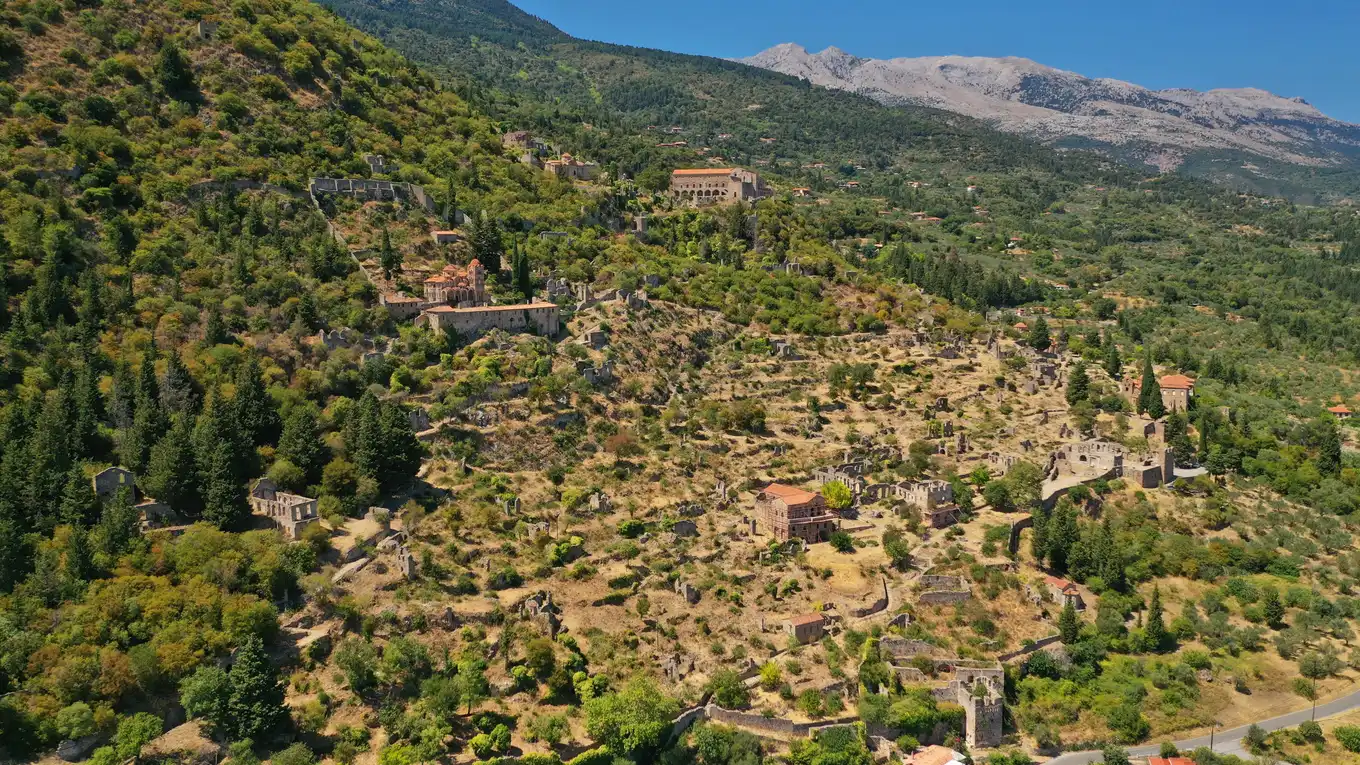
We’re saving the best for last—a “Mani-style” experience—and we’ll visit the beautiful port town of Gythio. In the “Land of the Gods,” as Pausanias called it, we’ll have time for a stroll along the waterfront, the obligatory coffee break, and then head back to Sparta for our final stop of the day: the castle town of Mystras! It literally “lurks” nearby—it’s very close, almost right next to Sparta—and transports us back to the Byzantine Empire… Stone-paved alleys lined with fortresses, churches, monasteries, palaces, and mansions take us on a journey into the past. A stroll through its stone-paved alleys is a journey through history that we’ll never forget. A visit to the Cathedral dedicated to Saint Demetrius is a must; it was here that Constantine Palaiologos was crowned emperor, the only emperor to be crowned outside of Constantinople. Arrival at the hotel.
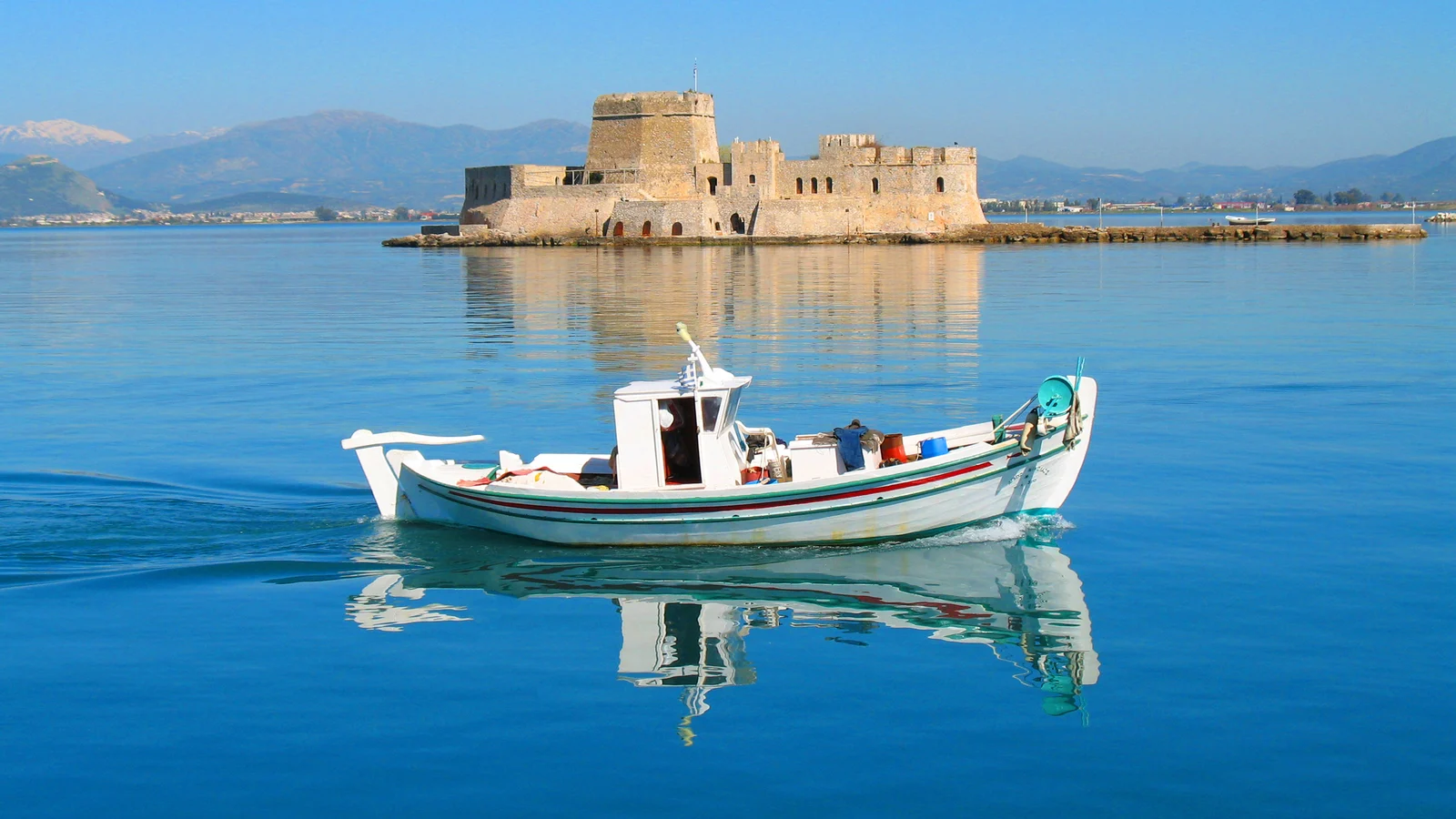
A hearty breakfast to recharge our energy, and then we set off for the enchanting Byzantine castle town in the southeastern Peloponnese. How can one describe Monemvasia, Ritsos’s “stone ship”!!—the birthplace of the great poet. We’ll become the protagonists of a medieval fairy tale with stone-built houses, Byzantine churches, and beautiful Venetian mansions! In Monemvasia, also known as the “Gibraltar of Greece,” you don’t even need a map! Follow the cobblestone streets and let yourself be swept away by the magic of the history of a settlement that once “hosted” all the emperors of Byzantium! With Ritsos’s house, the Church of the Coming Christ, the Church of Chrysafitissa, and the Archaeological Museum as landmarks, strolls through the castle’s narrow streets are steeped in the colors of the region’s heroic past. Free time. We leave the dreamlike castle town behind and head for the beautiful city of Nafplio. A stately city with a rich history that you simply cannot help but love. A beautiful setting that captivates me no matter how many times I see it. We’ll tour the most important sights, such as Syntagma Square, the Church of Saint Spyridon (where Ioannis Kapodistrias was assassinated), the Church of St. George (with important icons and frescoes, such as the copy of da Vinci’s “The Last Supper”), Three Admirals Square with City Hall, the Government House (or “Palataki”), as well as Philellinon Square. We recommend, as an optional activity, a ride on the tourist train that operates in Nafplio; it’s a unique way to tour the city and a fun experience for visitors of all ages. It departs from the city’s port and is especially popular with children, but it’s also a great option for adults, since in just half an hour you can see the city in a unique way. The tour is over!! We’ll have time to explore the main pedestrian street of Vasileos Konstantinou with its countless shops, Staikopoulou Street with its many little taverns, and Psaromachala, the oldest neighborhood, inhabited since the early 13th century. A friendly tip!! Look for “The Italian” [Antica Gelateria di Roma], which offers handmade Italian gelato and sorbet in various fruit flavors, or try “Mouhalébi” and a traditional cream dessert from the “Retro” dairy. Transfer to Tolo and check-in at our hotel.
We’ll enjoy a nice breakfast at the hotel and then head out for a cruise! You can spend your time in Tolo or join us on an optional excursion—a cruise to the two beautiful islands of the Saronic Gulf. Our first stop is cosmopolitan Hydra, the island with a rich maritime tradition and superbly preserved architecture. We’ll visit the Tombazis Mansion [now a branch of the School of Fine Arts], the historic home of Lazaros Kountouriotis, which has served as the National Historical Museum since 2001, the Cathedral (17th century) with its marble bell tower, as well as the Hydra Historical Archive-Museum, which impresses visitors with a unique exhibit, the silver urn containing the embalmed heart of Admiral Andreas Miaoulis. Free time to wander through the village’s narrow streets and enjoy a coffee at the picturesque harbor. Next stop: Spetses, another important naval power during the War of Independence of 1821. We’ll visit the house-museum of Bouboulina, the home of the island’s first governor, Hatzigiannis Mexis, Dapia, the old fort-harbor with its heavy cannons and exquisite mosaics made of round pebbles, while a little further on, the iconic Poseidonio building—with its classical architecture—stands imposingly on the waterfront, a landmark of Spetses. If you’d like, you can take a tour of this beautiful island in a horse-drawn carriage. Late in the afternoon, we return to the hotel for dinner and some free time to wander through the narrow streets of the area.
After breakfast at the hotel, we’ll make a very important stop at Epidaurus, the most significant ancient site of worship dedicated to the god Asclepius. It became famous throughout Greece for its Asclepieion, one of the most important healing centers of antiquity, and, of course, the ancient theater, a work by the architect Polykleitos, which remains unsurpassed even today in beauty and acoustics. It’s amazing that even an actor’s breath can be heard all the way to the back row! Next, our final stop in the Peloponnese will be at the castle that towers over the city of Nafplio and overlooks the Argolic Gulf: Palamidi! This imposing fortress rises 216 meters above the city of Nafplio, and you can visit it by driving up from the eastern side. The most daring and romantic visitors reach the summit via the 999 steps. It was built between 1687 and 1715 by the Venetians after they captured the hill on which it stands, following a fierce battle with the Ottomans during the Venetian-Turkish War. We will visit the so-called bastion “Miltiades,” which served as a prison for the hero of the Greek Revolution, Theodoros Kolokotronis, as well as the historic little church of St. Andrew the Apostle, built during the Venetian era. We’ll have time to take photos and enjoy the magnificent view from above. Impressed and enriched by the sights and experiences, we’ll head back.
The possibility of a refund and/or any deductions depends on the terms of the specific package, the timing of the cancellation, and the respective suppliers. For your specific case, please review the General Terms and Conditions or contact us.
Some packages include travel insurance, or optional coverage may be available, depending on the destination and itinerary. For available options and coverage terms, please contact us or refer to the General Terms and Conditions.
The reservation is finalized in accordance with the procedure set forth in the General Terms and Conditions (e.g., confirmation and payment of the amount/deposit, where required). For specific steps and deadlines applicable to this particular package, please contact us.
The itinerary is based on available routes and services; however, changes or adjustments may occur before and/or during the trip for operational reasons and/or due to unforeseen circumstances. In any case, the General Terms and Conditions of Participation apply, and relevant information will be provided.